Thursday, September 26, 2013

Jeremy Lin’s career: Is it Obsession or Dedication?

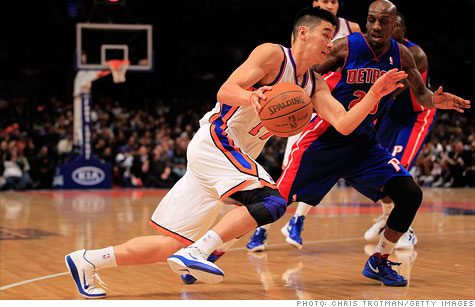
While reading Gooseberries by Anton Chekhov, Nikolay Ivanovitch seems obsessed with achieving one goal, but stagnates and maybe even declines after achieving that goal. He seems to live in a fantastical world where he is happy and successful, but realistically is gloomy and deteriorating in his house. Nikolay reminds me of Jeremy Lin two years ago.
Jeremy Lin was a Harvard student who probably had many options in his career with an economics degree, yet he chose to enter the NBA Draft his senior year. After remaining undrafted in this draft, he continued to pursue his career in basketball. Eventually, Lin signed a contract with the Golden State Warriors. He rarely played in his rookie year and was waived off the team in the next offseason. In the same year, Lin was added and dropped by the Houston Rockets. Lin was then picked up by the Knicks in December of 2011. After falling short three times in his career, Lin didn’t abandon his basketball career. Similar to Nikolay, could this be considered an obsession to achieve his goal as a successful basketball player or is this just dedication?

In 2012 with the New York Knicks, Jeremy Lin had a breakthrough season. He averaged 27.3 points, 8.3 assists and 2 steals per game in his first four starts with the Knicks. In these first starts he proved himself to be a great star and achieved great fame when the media and fans declared this to be “Linsanity”. Many sports analysts and fans believed he would become an All-Star Point Guard within the next couple years. In the offseason, Lin got traded to the Houston Rockets where he would become the first string Point Guard. Analysts, again, commented on his talents and how he will prosper with his new team and lead them into the playoffs. But, in the 2012-13 season, Lin struggled to put up high percentage shots. The Rockets lost seven of their first twelve games. Although he is still very young and has time to improve, Lin’s 2012-13 season was not very impressive. Could this struggling, dull season represent the stagnation Nikolay went into after achieving his ultimate goal? 


Thursday, September 19, 2013

Ronaldo v. Messi: The Chronological History of Rivalry


Ronaldo v. Messi: The Chronological History of Rivalry

Written by: Vincent Cao

           
            The rivalry between Ronaldo and Messi has been the topic of interest for the recent soccer filled century. Who is truly better? Is it Messi with his eloquent dribbling, masterful passing, and expert team leadership? Or Ronaldo, with his flair, his goal scoring drive, and his “clutch” ability? This week, amidst the Champions League matches, Ronaldo scored a hat trick in Istanbul on Tuesday. Following this spectacular demonstration of talent, Messi answered skeptic critics of his superior role to Ronaldo by scoring a hat trick in Barcelona. According to various articles, with titles such as “Messi Can Be Upstaged, but Not for Long,” sports enthusiasts have claimed that Messi’s talent outweighs that of Ronaldo. This situation parallels the importance of the topics covered in class. In class, we discussed the importance of chronology within literary works, with technical terms such as analepsis and prolepsis. These important topics apply to the perception on the rivalry between these two soccer figures. As an audience, had we encountered flashbacks into the seemingly overwhelming success that Ronaldo experienced, overshadowing Messi’s career, would we perceive Ronaldo to be superior to Messi? With Messi being two years younger than Ronaldo, would a prolepsis ultimately reveal Ronaldo’s career gradually declining before Messi’s career? Or what about an example of in media res, in which we, as the audience, are immersed within the middle of both of their careers. Would their struggle and competition fit into context? Or would they just be painted as two successful, separate soccer players. Currently, soccer fans find it impossible to discuss Messi without discussing Ronaldo, or vice-versa. The questions, however, that remains  encompass how chronology played a part in shaping this rivalry, this epitome of intense competition. As viewers to this worldwide phenomenon between two individuals, we are subjected to the influences of time. We judge these men based on each of their performances in relation to one another. If Messi were to perform poorly after Ronaldo performed exceptionally, journalists would immediately be sparking up headlines on the ousted champion of soccer. However, what if Ronaldo were to perform exceptionally after Messi performed poorly? Would this situation still change our perception on the standings among this rivalry?

            Throughout this entire situation, we viewers can map out the rise and fall of this rivalry. With regards to the exposition, rising action, climax, falling action, and resolution, a specific moment in both Ronaldo’s and Messi’s career can be identified as a component of a larger scheme. But who ultimately wins in the end? That’s the golden question. 


“Messi Can Be Upstaged, but Not for Long”


Thursday, September 12, 2013

Fantasy or Reality?

BY: VIRESH

            Many athletes today are criticized for the activities they participate in outside of their specific sport.  Vast criticism takes place at college campuses, where teenagers are becoming young adults. In this transition, I believe many college athletes tend to exhibit two separate, yet very unique lives/perspectives. These unique personalities relate to Connie’s unique characteristics in the short story Where Are You Going, Where Have You Been? by Joyce Carol Oates. Connie’s unique personalities did not coexist in the same environment. Connie’s timid and more mature personality exists while she is at home while her outgoing and affectionate personality exists when she is away from home.

Similar to Connie’s altered personality at home and away from home, I believe athletes have altered personalities on the field and off the field. On the field, athletes are mature, disciplined, respectful and responsible. Off the field, an athlete is free from responsibility and maturity. On the field, an athlete is developing his/her career. Off the field, an athlete is a common, ordinary person who attends parties and socializes with friends. These personalities do not coexist so, which of these personalities are reality?

            One perspective is that an athlete’s personality on the field is reality, while his personality off the field is fantasy. Sports analyst and sports media usually agree with this view, which greatly influences common public moral that maturity, manner and responsibility as well as a career goal should be considered reality. This perspective was supported by June’s parents, who praise June for being responsible, intelligent but simple.  This personality would probably be ideal to majority of people and can be argued as reality because their definition of reality consists of words like discipline and stable job or good paying job.

On the other hand, some people believe that an athlete’s personality off the field is reality, while his personality on the field is fantasy. This can be argued to be reality because it portrays true expression. Outside of her home, Connie was outgoing and expressed herself the way she felt she really was, something she couldn't do at home due to the disapproval of her parents and other relatives. Similarly, athletes can express themselves with their own unique personality when they are not placed in front of a camera.

One recent example of these differing personalities were Johnny Manziel who was criticized for being at “a rival school’s frat party and an autograph fiasco that got him suspended for the first half of the 2013 opener”. 


The full article about Johnny Manziel and the criticism he encountered is here:


Wednesday, September 4, 2013

The fiction of Roger Federer losing: A literary or commercial story?

Written by: Vincent Cao


After Roger Federer’s recent loss in the fourth round of the U.S. Open, writers alike have been rapidly tackling new headlines on this tragedy. According to the Slate, “The greatest tennis player of all time has become mortal. Now maybe we can finally appreciate him.” Has this become the stuff that resembles fiction? How can a man who triumphantly topped the rankings and garnished a lifetime’s worth of accolades and Gland Slam Championships become a scapegoat among writers? As we examine more into the life of Roger Federer and his path to success and recent “failure”, we are conflicted whether his fictionalized life would be the material for commercial fiction or literary fiction. This story plays out very similarly to a hero-based novel; the hero/protagonist rises to fame prevailing over every opponent, yet eventually falls to obscurity. In class, analysis on commercial fiction has demonstrated that the purpose of commercial fiction is capital gain; commercial fiction acts a medium for escape from the stress of life. Like memorable tennis matches, commercial fiction is full of “tricks and surprises.” Indeed, a motivating factor for Federer is capital gain, but there is much more to his motivation. It can be said in commercial fiction that the reader is sympathetic toward the hero and the defined plot usually ends with a happy ending, ultimately affirming conventional views of the world. Has the story of Roger Federer captured the essence of commercial fiction? Are we as fans or observers sympathetic toward his fall from the Olympus grandeur of tennis legends? I admit that there has been a defined plot throughout the success of Federer; he starts out as a young, ambitious tennis player who claws his way to fame. However, does this losing chapter in his tennis career fulfill the commercial’s attribute of suspense?

            On the other hand, we need to conduct analysis on literary fiction as well. Usually, literary fiction’s purpose encompasses artistic demonstration to broaden or deeper a reader’s awareness of life. Are we as spectators of one of tennis’ greatest players exposed to lessons on life? Has his persistence and success led us to question the factors needed to craft a champion? Undeniably, tennis, to some, and literary fiction bring pleasure and understanding. Tennis and literary fiction both dispel illusions and provide insight into the nature of human experience. When watching Federer, we dispel illusions that sport does not require luck. As we watch Federer’s send a beaming backhand cross-court shot toward his opponent, we are reminded that hard work in combination with talent along with human experience has allowed for this perfection. Although it may be presumptuous to say that the model of Federer may challenge world views, I still believe that Federer has a lot more to offer to society as a whole besides entertainment. Federer serves as a role model and can easily be associated with the greatest heroes in fiction: Achilles, Sherlock Holmes, Gandalf, and Leopold Bloom.


            Common in all types of fiction, a hero’s downfall is usually brought by one character flaw. The question is, what is Federer’s?